Thursday, September 17, 2009

Starting your blog

As we talked about today, here is some stuff to keep you busy:
  • Sign up for a google account and start a blog at bloggger.com that you can use for your posting this semester. Send me the link to your blog when it is up and running, and be sure to pick a great name.
  • Write an introductory post for your blog. What is its purpose, what will you use it for, who is your audience, etc.
  • Look into the work that Randy Olson has done in science communication. He has his own web site, videos on You Tube, and various writing about science communication spread across the web.
  • Set up a Google Reader account and start subscribing to blogs that interest you. This is a great way to scout out some ideas for your own posts.
That will be good for now. I will be looking out for your progress and will comment along the way.

Friday, September 4, 2009

Amy's second assignment

Here is the library link to the Science in Public book we read for this week if you would like to check it out.

And here are your assignments for this week:
  • Start reading science blogs and leave a comment to this post naming your favorite and explaining why. Here is a good post on how to find science blogs.
  • Also look at some blogs or websites on science communication and leave a comment about that here as well.
  • Check out the COPUS website.
And here is some reading for next week on effective science writing. Both of these books are in the AU library:
Leave any comments or questions you have in the comments section of this post. I will be checking it each day (no pressure).

Thursday, April 23, 2009

Departmental BBQ

Saturday, April 18, 2009

Some interview tips

Thought you might find these of interest:  How to nail an interview.

Tuesday, April 14, 2009

Some interesting career news

An informative post on how careers are changing in the U.S.  I think it supports our discussions about the important of communication skills, and the need to be a life-long learner.

The data do not break out medical and science fields in particular.  I think if they did, the job outlook for the biology graduate would look even better.

Friday, April 10, 2009

Forgotten Plan B

I forgot to mention that you can choose to produce a short (2-3 minute) video as a joint project instead of doing an individual Powerpoint presentation.  The Southern Fried Scientist had his Invert Zoology students make videos based on science papers.

Videos are an excellent way to convey science.  Want to learn about barnacles?:


Thursday, April 9, 2009

The power of Powerpoint

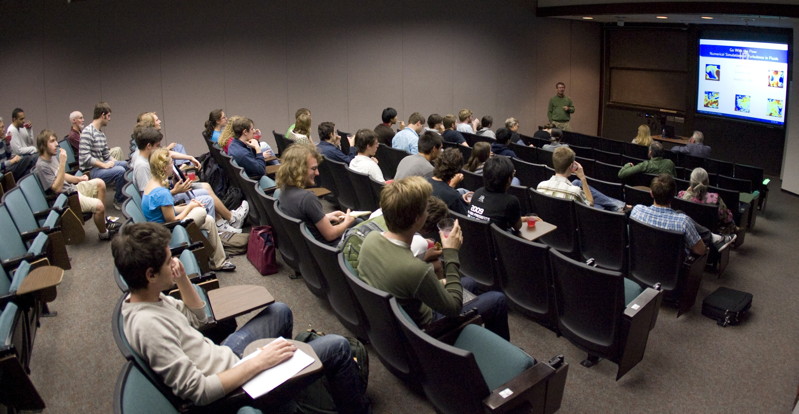
We have spent much of the semester practicing how to present science in writing through your blog posts.  For your last assignment of the semester you will work on another vehicle for conveying science - through voice and slides.  Powerpoint has become ubiquitous and often parodied, but we can't escape the reality that it is a dominant medium for conveying information.  Even if you do not go into a career that requires the standard science Powerpoint presentation, Powerpoint skills will likely be important in your future career.

So your assignment is to develop and deliver a 5-minute Powerpoint presentation on any topic you would like in Biology.  This can be something that you know well and want to teach other people about.  Or it can be something that you don't know well, but want to know more about.

5-minutes is short - perhaps time for about 5 slides.  But this is enough time to give a basic introduction and then push the envelope a bit.  Don't just present the basics - give some deeper information as well.  And of course, it should be interesting.

As I mentioned on Wednesday, write a post to your blog with a brief description of what you plan to present by next week's class.  First come first served on the topics.  And think about whether you would like to present on April 22nd or 29th.  We will split the class between those two days.